Why Your Dog Shouldn’t Work for Free
Why your dog should not work for free: a myth-busting guide to rewards, cooperation, and ethical dog training that builds real partnership.
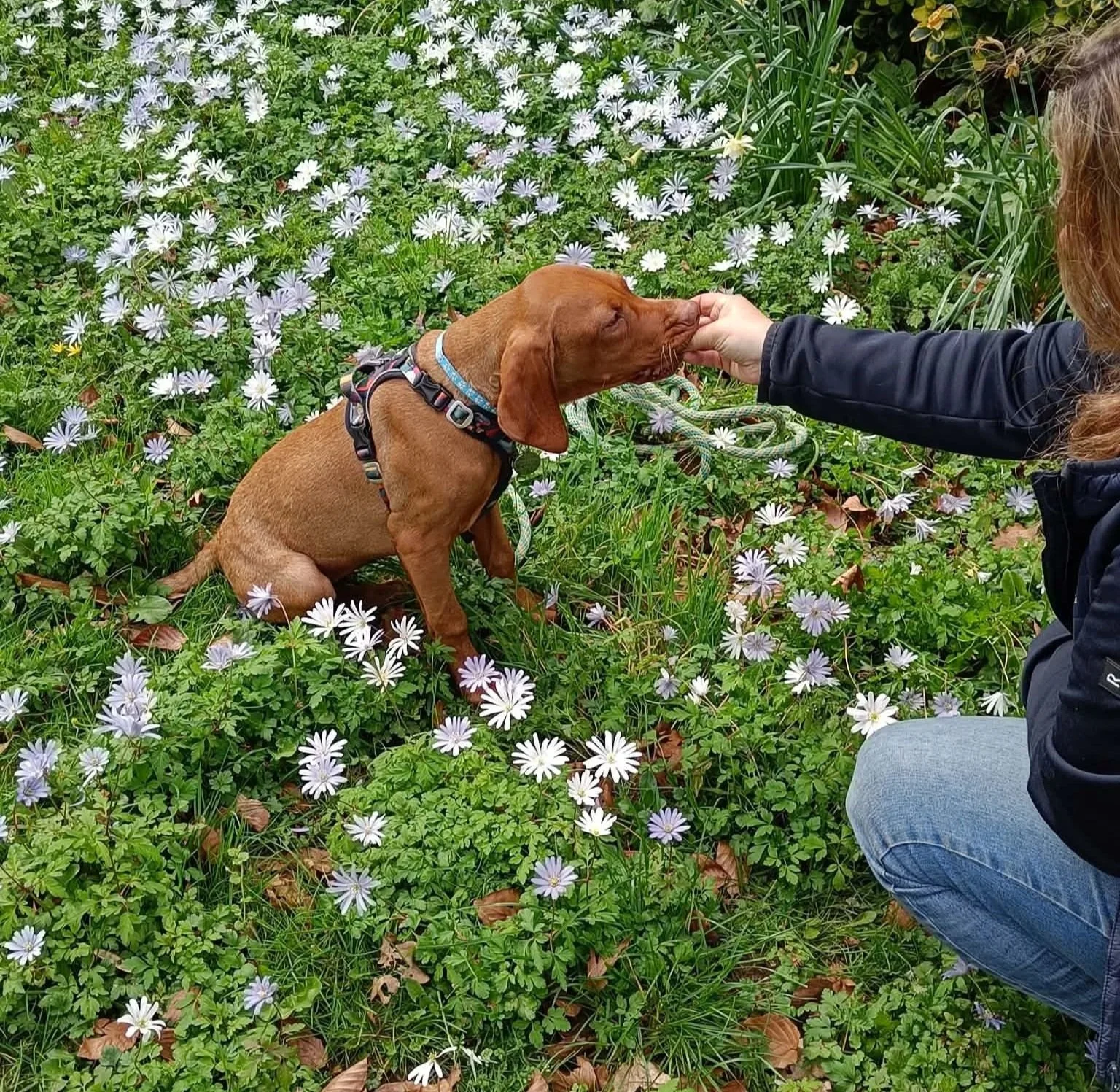
Vizsla puppy taking treat in a field of flowers
Working for free is not respect. It is a bad deal.
Your dog does not owe you effort.
Not their focus. Not their cooperation. Not their best work just because you turned up with a whistle, a lead, or a strong opinion about what a "good dog" should do.
And yet, a lot of dog training still leans on exactly that idea. Especially in working circles. The dog should do it because you asked. Because they should respect you. Because that is what a proper dog does.
No.
That is not a training philosophy. That is an ego trip.
If you want to understand why your dog should not work for free, start here: behaviour worth repeating has to be worth the dog's while. That is not spoiling them. That is not weakness. And it is not bribery. It is training.
Clean, honest, effective training.
Dogs Trust explains it in straightforward terms: when your dog gets something they want for behaviour you like, they are more likely to do that behaviour again. RSPCA is equally clear that training should be reward based, using food, toys, or praise the dog values.
Because here is the bit people still get odd about. Rewards are not bribes. They are paychecks.
A bribe is what you start waving around when you have not trained the thing and you are trying to patch over the cracks. A paycheck is part of the deal. You do the work, you get paid. Work, reward, recover. Simple. Fair. Good business.
That shift in thinking changes everything. It takes you out of the old nonsense about dominance, respect, and who is in charge, and puts you back where good training actually lives: clarity, motivation, repetition, and trust.
Drift is a working-line Vizsla. She is being trained through cooperation, not control. No force. No dominance. No pain, no fear, no intimidation.
Just good business.
Myth: good dogs should work just to please you
This one hangs around because people like the sound of it.
We like to imagine our dogs gazing up at us, desperate to make us proud, working out of pure devotion and impeccable manners. Lovely image. Not much use in training.
Dogs do not perform behaviours because they admire our status. They perform behaviours because those behaviours have a history of paying off, making sense, or feeling safe enough to offer again. That is how learning works. Dogs Trust says training with rewards teaches dogs that good things happen when they make good choices. That is a much more useful foundation than "because I said so".
And this matters even more when you ask for real work.
Retrieving. Recall. Hunting in cover. Holding focus around scent, movement, noise, and excitement. None of that is improved by your dog being guilt-tripped into compliance. If anything, the old "they should just do it" mindset creates muddle. You stop looking at what is reinforcing the behaviour. You stop asking whether the dog understands the task. You stop noticing the moments where motivation drops because the payment, pressure, or picture has changed.
Then people call the dog stubborn.
Convenient, that.
But stubborn is often just a label humans use when the training plan is weak and the dog has stopped finding the deal worthwhile.
This is where a lot of traditional handling goes wrong. It treats motivation like a character test. A good dog will do it. A lesser dog will not. But motivation is not morality. It is information. If your dog is flat, disconnected, slow, avoidant, or constantly scanning for ways out, that is not rudeness. That is feedback.
Useful feedback.
RSPCA advises avoiding trainers who rely on fear, pain, choke chains, shouting, or hitting, and instead recommends reward-based methods with food, toys, or play.
So no, your dog should not work just to please you.
Can they enjoy working with you? Absolutely.
Can they love the game, the pattern, the search, the retrieve, the shared rhythm of it all? Yes.
But that does not happen because they were born owing you labour. It happens because you build a system where the work feels clear, worthwhile, and safe to do.
That is partnership. Not entitlement.
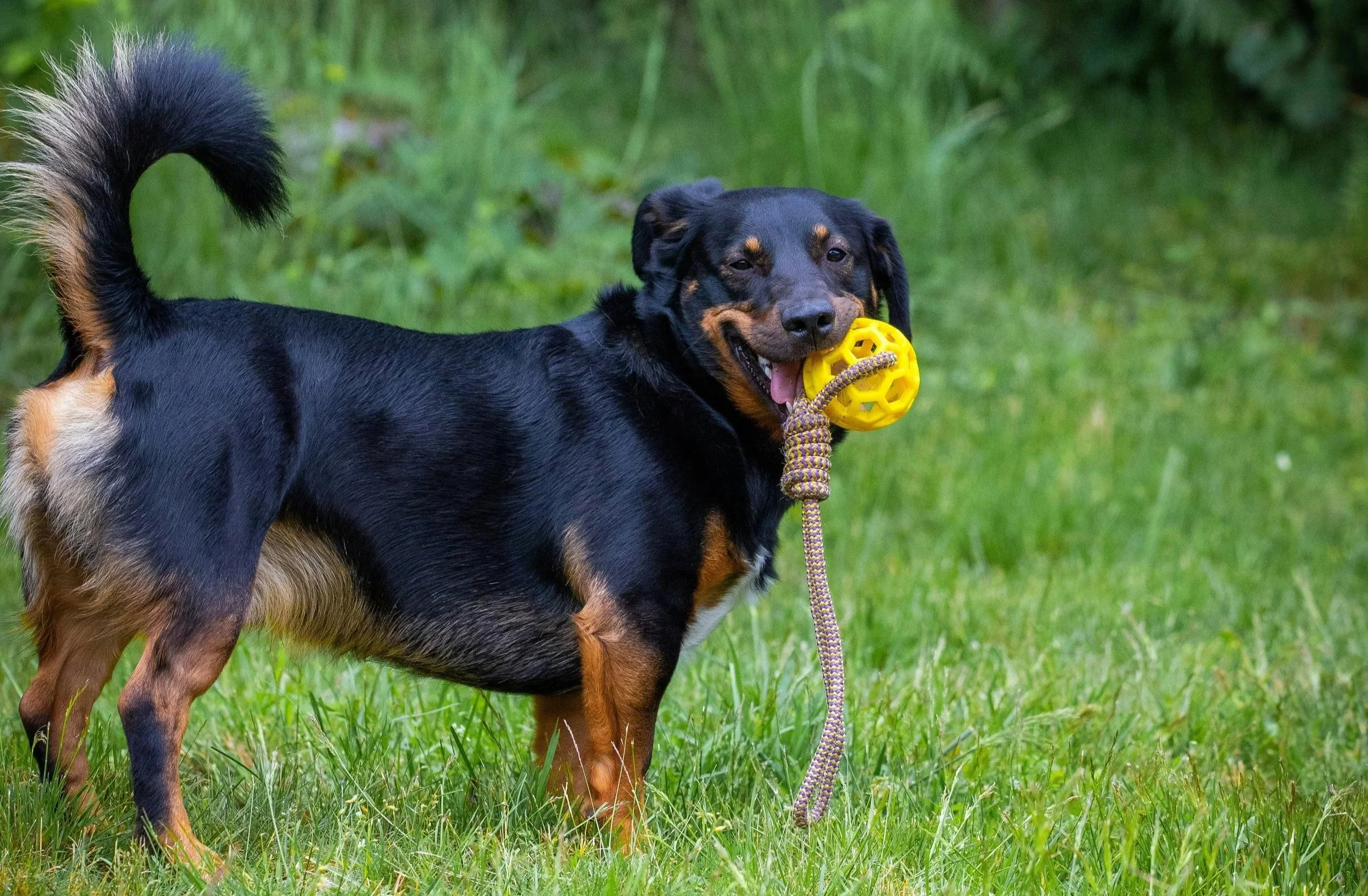
Black and tan dog with rope ball toy in his mouth. Photo by Christoph Sixt: https://www.pexels.com/photo/a-dog-playing-outdoors-with-a-toy-7766297/
Rewards are not bribes. They are paychecks.
Let's deal with this properly.
A bribe comes before the behaviour to beg for it.
A reward comes after the behaviour to reinforce it.
That is the simple version. Not the whole story, but the version most people need.
If you are dangling a biscuit in front of your dog's nose every time you need them to function, yes, that is clumsy. But clumsy use of food is not the same thing as reward-based training being flawed. It just means your mechanics need work.
The answer is not to throw the rewards out. The answer is to get better at using them.
Dogs Trust describes positive reinforcement as giving your dog something they want when they behave in a way you like, so they are more likely to do that behaviour again. RSPCA says the same: reward the behaviour you want with something the dog really likes, and they are more likely to repeat it. That is not bribery. That is learning.
And payment does not only mean food.
It might be:
a piece of roast chicken
a thrown retrieve
a tug toy
praise
access to a sniff
the chance to move forward
release back into the job
Different dogs value different things. Different moments need different rates of pay. That is not a problem. That is the work.
Because here is the thing people miss: in good training, the reward is information as well as payment. It tells the dog, yes, that bit. That choice. That speed. That line. That effort. Do that again.
Clear dogs learn faster.
And they work better.
Dogs Trust even gives examples of using high-value food for focus work and varying rewards to keep training effective and enjoyable.
So flip the script.
Stop asking, "How do I get my dog to do this without needing a reward?"
Start asking, "What payment makes sense for this task, in this environment, at this stage of learning?"
That question will make you a better trainer overnight.
A simple rhythm helps:
Work. Reward. Recover.
Work with clarity. Reward with honesty. Recover before the dog empties out.
That rhythm matters. Especially with high-drive dogs. Especially with working breeds. Especially with dogs who look flashy until the wheels come off.
Because burnout is not brilliance. And compliance under pressure is not the same as confident understanding.
What changes when you train for cooperation, not control
Everything.
The feel of the work changes first.
A dog trained through cooperation looks different. They are not just doing the behaviour. They are in it. More present. More engaged. More available. You get less conflict, less bargaining, less emotional fallout after the task.
Not because they are shattered.
Because they are satisfied.
When the dog understands the game and trusts the process, you tend to see sharper focus, quicker re-engagement, steadier effort, better frustration tolerance, clearer body language, and less avoidance when the task gets hard.
That is not wishful thinking. A 2020 study by Vieira de Castro et al., published in PLOS ONE, compared dogs from reward-based and aversive-based training schools. Dogs trained with aversive methods showed more stress-related behaviours during training, spent more time in tense or low body states, and had higher cortisol levels afterwards. The same study also found more pessimistic judgement patterns in dogs exposed to higher proportions of aversive training, suggesting welfare effects that extend beyond the session itself.
That matters if you care about working performance.
Because a dog under pressure may still move. They may still retrieve. They may still recall. But what is the quality of that work? What is the emotional cost? And what happens when the environment gets difficult, the stakes go up, or the dog has one bad experience too many?
Control can get you behaviour in the moment.
Cooperation gets you behaviour you can live in.
This is especially important with sensitive, driven, thinking dogs. The sort of dogs people love to call "too much" when really they are just wide open to the world. Working-line dogs often have big engines. Big feelings too. If you train as though motivation and emotion are irrelevant, you will end up fighting the very qualities you could have channelled.
Drift is a good example of the better option.
A working-line Vizsla is not a robot in a rust-coloured coat. She is a learner. An athlete. A problem-solver. A dog with instincts, opinions, and a nervous system that matters. Train that dog through cooperation and you do not lose standards. You gain understanding.
And understanding travels.
From the field to the walk. From the recall to the settle. From the retrieve to everyday life.
That is why this method is not about being soft. It is about being skilful.

Vizsla puppy pointing. Photo by Lee Pullen Photography
But won't rewards make my dog dependent?
This is the favourite objection of people who want the benefits of reinforcement without the inconvenience of actually reinforcing.
No, rewards do not make your dog weak.
Messy training makes your dog wobbly.
There is a difference.
If your dog only works when they can see a biscuit in your hand, that does not prove rewards are the problem. It usually proves the reward has become the cue, or the behaviour has not been built properly yet. That is a mechanics issue. Not an argument against payment.
Dogs Trust recommends using rewards your dog really values and mixing them up to keep training strong. Good trainers do not randomly stop paying and hope for the best.
They build fluency.
They build understanding.
They reinforce generously while the dog is learning, then get smarter about timing, variety, and context. Sometimes the paycheck is bigger. Sometimes smaller. Sometimes the reward is immediate. Sometimes it comes after a short chain of work. But the dog still trusts that the work pays.
That trust matters.
Because unreliable payment creates uncertainty. And uncertainty creates fallout. Slower responses. Scrappier behaviour. More checking out. More stress. Less heart in the work.
No one is surprised that humans work better when the job is clear and the pay is fair. Yet hand someone a dog and suddenly we are expected to believe that wanting payment is somehow grubby.
Strange, really.
Here is the cleaner way to think about it: a visible treat is not the goal. A strong reinforcement history is. The dog does not need to see the paycheck in advance. They do need to believe the system is worth investing in.
That belief is what gives you effort.
Not lectures. Not posturing. Not "they should".
No pain. No fear. No intimidation. Non-negotiable.
Let's be plain.
Force is not a shortcut to good training. It is often a shortcut to fallout.
RSPCA says to avoid trainers who use fear, pain, shouting, choke chains, or hitting. Dogs Trust's guidance centres positive reinforcement and building a lifelong bond through reward-led training.
That does not mean standards disappear.
It does not mean dogs get to do whatever they like.
And it does not mean working dogs cannot be trained to a high level.
It means the route matters.
No pain. No fear. No intimidation.
Those are not sentimental extras. They are welfare basics.
And welfare is not separate from performance. It sits underneath it. A dog who feels safe enough to think, try, recover, and re-engage is a dog who can keep learning. A dog who is worried about getting it wrong may still do the task, but you are now training around stress as well as skill.
That is a poor bargain.
The Vieira de Castro study keeps pointing in the same direction: aversive methods carry welfare costs, and reward-based approaches can achieve training goals without those same costs.
So when someone tells you rewards are soft, or force-free training is unrealistic, or proper working dogs should not need paying, it is worth asking a better question.
Better for whom?
Better for the dog? Better for learning? Better for long-term reliability? Better for the relationship?
Usually, the answer tells on itself.

Brown working cocker spaniel, Vizsla puppy and dapple Cockapoo sitting on a wall. Photo credit Lee Pullen Photography
Pay the dog. Build the partnership. Get better work.
Your dog does not owe you effort, focus, or cooperation.
That has to be earned. And yes, it has to be paid for.
That is not cynical. It is not transactional in a cold way. It is honest. It respects the fact that dogs are active participants in training, not props in our little power fantasy about obedience.
The old idea that a dog should work out of "respect" sounds tidy, but it gives you nothing useful. It does not tell you how behaviour is built. It does not tell you how trust is maintained. And it definitely does not tell you how to create a working partnership that can hold up under pressure.
Rewards do.
Rewards give the dog information. Rewards build motivation. Rewards create clarity. Rewards keep the conversation worth having.
And no, that does not make them bribes.
It makes them wages.
Drift is being trained through cooperation, not control. No force. No dominance. No pain, no fear, no intimidation. Just a dog learning that working with her person is clear, worthwhile, and safe.
That is the method.
And it works because it makes sense.
If you want a dog who is calm, controlled, focused, and genuinely with you in the work, stop asking them to labour for free. Pay well. Be clear. Keep the deal fair.
Work, reward, recover.
That is not lowering the bar.
That is raising the standard.