The Truth About "Low Maintenance" Dog Breeds

The myth of low maintenance dog breeds is harming welfare.
Learn what dogs actually need and why behaviour problems are often misunderstood.
You've seen the lists.
"Perfect apartment dogs."
"Low maintenance breeds."
"Easy companions for busy lives."
Neat. Simple. Reassuring. And completely misleading.
There is no such thing as a low maintenance dog. Not really. There are only dogs whose needs are either understood or suppressed. And that difference matters more than we like to admit.
Articles built around selling breeds lean on the same tired framework. Small equals manageable. Calm equals easy. Certain breeds packaged as ideal for modern living. It sounds helpful. Like a shortcut to getting it right. But what those articles are really doing is matching a dog to a lifestyle on paper, without ever asking what the dog needs to do each day to feel like itself.
Dogs are not categories. They are individuals shaped by genetics, learning, environment, and experience. When we reduce them to convenience labels, we don't just oversimplify them. We lower the standard of care we expect to provide.
When you bring a dog into your life based on how little you think they will need, you stop looking for what they actually require. Behaviour becomes something to manage rather than something to understand. Needs become inconveniences. Expression becomes something to tone down.
We dress it up as a good life. Warm home. Expensive food. Plenty of love.
But welfare is not measured in comfort alone.
Modern welfare science is clear on this. A good life for an animal includes the ability to express natural behaviour, to have some control over their environment, and to engage in meaningful activity (Mellor et al., 2020). Not just rest. Not just routine. Not just being easy to live with.
Expression. Agency. Purpose.
Take those away, and behaviour doesn't disappear. It changes shape.
The terrier still needs to dig, so they go for your carpet. The collie still needs to control movement, so they fixate on bikes or children. The spaniel still needs to hunt, so they "won't listen" outside.
And suddenly the dog isn't "low maintenance" anymore. They're difficult. Reactive. Stubborn.
This is not about blaming owners. It is about changing the question. Because the real problem is not that dogs don't fit our lives. It is that we have been told they should. And when they don't, we assume the dog is the problem.
They're not.
This Myth Is a Welfare Problem
Calling a dog "low maintenance" doesn't make them easier to live with. It makes them easier to misunderstand.
Breed lists are built for human convenience. They sort dogs by size, energy, grooming, noise. Useful on paper. Dangerously incomplete in practice. Because none of those categories tell you what the dog actually needs to do.
The Five Domains Model makes it clear that good welfare isn't just about avoiding harm. It is about enabling positive experiences, including behavioural expression and agency (Mellor et al., 2020). Your dog needs opportunities to be a dog. Not just fed. Not just walked. Not just kept out of trouble. Allowed to sniff, search, solve problems, make choices.
When we label a breed as "low maintenance," we quietly lower our expectations of those needs. We expect less behaviour, less expression, less demand. But the dog hasn't changed.
So the behaviour shows up anyway. Only now it's labelled as a problem.
Digging becomes destruction. Barking becomes nuisance. Chasing becomes reactivity. Independence becomes stubbornness.
Same behaviour. Different story.
Once it's labelled, the focus shifts. Not "what does this dog need?" but "how do I stop this?" That is the moment welfare starts to slip.
Stop asking: is this breed easy? Start asking: what behaviours does this dog need to express daily? That is the question that actually keeps you both out of trouble.
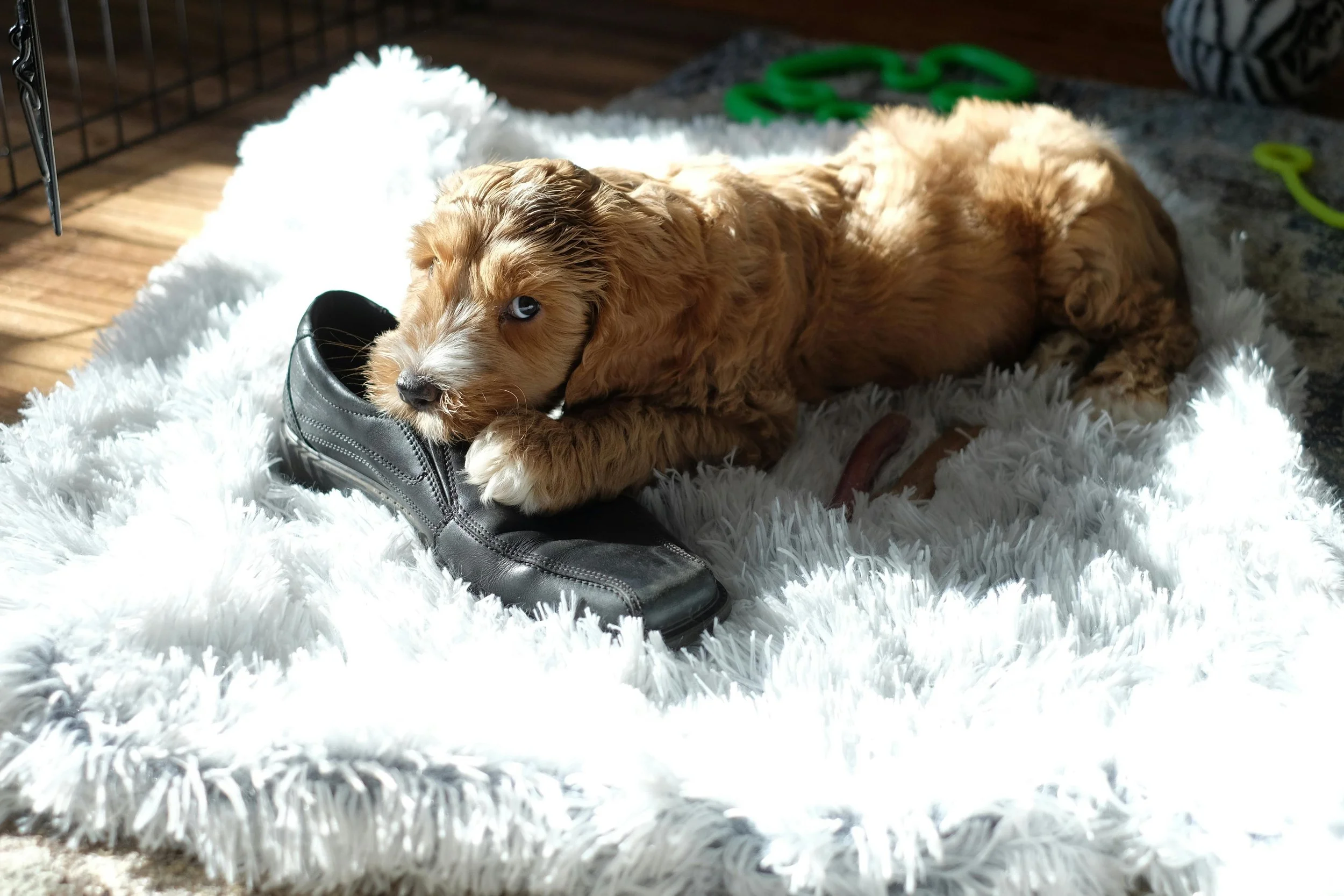
Photo by mister088: https://www.pexels.com/photo/cute-puppy-chews-shoe-on-fluffy-rug-31299147/
Bred for a Job, Living Without One
A dog doesn't forget what they were bred for because we bought them a memory foam bed.
Genetics matter. Not in a neat, predictable way, but in tendencies, drives that shape how a dog interacts with the world. And those drives don't disappear in a well-decorated home. They wait.
A collie notices movement. Always has. Always will. A terrier looks for opportunities to dig, shred, dismantle. A hound follows scent as though it is the only thing that matters, because to them it is.
Take those drives. Remove the outlets. Limit the opportunities.
What you get is not a calm dog. You get a frustrated one. And frustration leaks.
It shows up as restlessness in the house, overreaction on walks, obsessive behaviours, or not coming back when called. Not because the dog is difficult. Because the need hasn't gone anywhere.
Comfort is not fulfilment. A fulfilled dog is one that gets to use themselves. Their nose, their brain, their body, their instincts. Without that, behaviour becomes an attempt to meet a need in whatever way is available.
Watch what your dog keeps trying to do. That is your starting point. Meet that need deliberately, and everything else gets easier.
The Myth We Still Haven't Let Go Of
When behaviour shows up, we still reach for old explanations. And the most persistent one is dominance.
"Nothing in life is free."
"Learn to earn."
"You have to be the pack leader."
These ideas have been around long enough that they feel like common sense. They aren't. They're built on a fundamental misreading of how dogs actually work.
The dominance model was borrowed from outdated wolf studies, observations of captive, unrelated wolves forced together in artificial conditions. Wild wolves, it turns out, form cooperative family groups, not rigid hierarchies enforced through control (Bradshaw, Blackwell & Casey, 2009). And domestic dogs are not wolves. They have spent thousands of years evolving alongside humans, not competing with them.
Dogs are not trying to take over your household. They are trying to navigate it.
So when "nothing in life is free" gets applied in practice, what actually happens? Access to food, movement, rest, and interaction gets restricted until the dog complies. It's framed as structure. As respect. But what it does is remove agency. And agency is a welfare need (Mellor et al., 2020).
A dog living under constant resource restriction is not a dog learning good manners. It is a dog under chronic low-level stress. And chronically stressed animals don't learn well. They cope. They shut down, or they push back, and when they push back, the behaviour gets labelled as defiance, which leads to more control, which leads to more stress.
It is a cycle that serves no one. Least of all the dog.
The research is clear on this. Aversive, control-based methods are associated with increased anxiety, increased aggression, and a weaker relationship between dog and owner (Bradshaw, Blackwell & Casey, 2009; Bradshaw, 2011). Positive, relationship-based approaches produce better outcomes on every measure that matters.
No pain. No fear. No intimidation. Not because it sounds kind. Because it works.
If a method depends on controlling what a dog can access in order to force compliance, question it. Real trust is not built through restriction. It is built through consistency, clarity, and meeting needs.
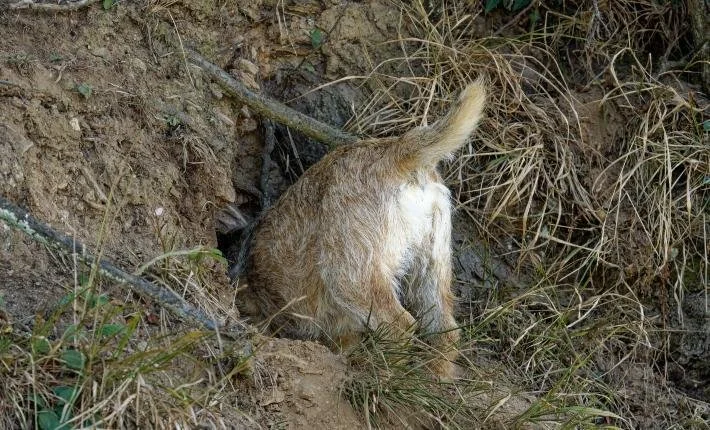
Terrier searching down animal hole
Apartment Dogs Don't Need Less. They Need Different.
It is not about space. It is about opportunity.
Dogs don't struggle in apartments because of size. They struggle when their needs aren't met within that space. A fulfilled dog can live anywhere. An under-stimulated dog struggles everywhere.
This is where people often get stuck. They try to solve behaviour with more walking, more physical exercise, longer outings. But tired is not the same as calm. A physically exhausted dog can still be mentally frustrated. Still restless. Still reactive.
What actually changes behaviour is fulfilment. A simple rhythm your dog can rely on.
Work. Let them use their brain and instincts. Scent games, food searches, problem-solving toys.
Reward. Reinforce the effort with food, play, or social interaction.
Recover. Real rest, not shutdown. Quiet space, low stimulation, the choice to disengage.
A 10-minute scent game can do more for your dog than a long, overstimulating walk, because it meets a need. When needs are met, behaviour settles. Not because the dog is shattered. Because they are satisfied.
In practice, this might look like sniff-first walks instead of heel-focused marches, scatter feeding instead of bowl feeding, or letting your dog choose the pace and route where it is safe to do so. Small shifts. Significant impact.
Conclusion
There is no such thing as an easy dog. Only dogs who fit neatly into our expectations, and dogs who don't.
The problem is not the dog that struggles. It is the expectation that they shouldn't.
Labels like "low maintenance" reduce living, thinking animals into convenience categories. And when reality doesn't match the label, we reach for control rather than understanding.
But behaviour is not disobedience. It is communication.
When you start there, everything changes. You notice patterns, meet needs, build trust. And you end up with something far more valuable than an easy dog. You get one who feels safe, who can settle, who can engage with the world without conflict.
Not because they have been managed. Because they have been understood.

Photo by Pavel Danilyuk: https://www.pexels.com/photo/brown-dog-on-the-chair-7055637/
References
Bradshaw, J.W.S., Blackwell, E.J. and Casey, R.A. (2009). Dominance in domestic dogs: useful construct or bad habit? Journal of Veterinary Behavior, 4(3), pp. 135–144.
Bradshaw, J.W.S. (2011). In Defence of Dogs. London: Allen Lane.
Mellor, D.J., Beausoleil, N.J., Littlewood, K.E., McLean, A.N., McGreevy, P.D., Jones, B. and Wilkins, C. (2020). The 2020 Five Domains Model: including human–animal interactions in assessments of animal welfare. Animals, 10(10), 1870.