Why Your Labrador or Cocker Feels Harder to Train. Show Lines vs Working Lines Explained
Do You Actually Know What Dog You Are Buying?
Who this article is for
This is written for pet dog owners. Not field trial handlers. Not show breeders. People who want a dog to live in their house, walk on a lead, come back when called and not make everyday life harder than it needs to be.
I use Labradors and Cocker Spaniels because they are the dogs I see most often in my work. The principles apply much more widely, but these are the breeds causing the most confusion in real homes.
Left Show line Cocker Spaniel. Right Working Line Cockder Spaniel.
Show line or working line. Does it really matter?
Short answer. Yes.
Longer answer. It matters a lot more than most people realise.
Show lines and working lines share a breed name but they are bred for different outcomes. That affects how the dog looks, how their brain works and how easy they find living in a human world.
Neither is better. But they are not interchangeable.
What show line actually means
Show line Labradors and Cocker Spaniels are bred to meet a written breed standard.
That means structure, coat, outline and movement are prioritised. Temperament still matters, but the pressure is on how the dog looks and moves rather than how hard it can work all day.
In pet homes this often translates to
slower maturity
lower baseline arousal
better tolerance for down time
easier off switches
These dogs still need training and enrichment. But they generally cope better with pottering, routine walks and family life.
What working line actually means
Working line Labradors and Cocker Spaniels are bred to do a job.
That job involves stamina, speed, problem solving and the ability to stay switched on for long periods under pressure.
In pet homes this often shows up as
high energy
strong environmental awareness
pulling on the lead
difficulty settling
frustration when under stimulated
These dogs are not badly behaved. They are doing exactly what they were bred to do.
Physical differences you can actually see
This is not just about behaviour. Bodies matter.
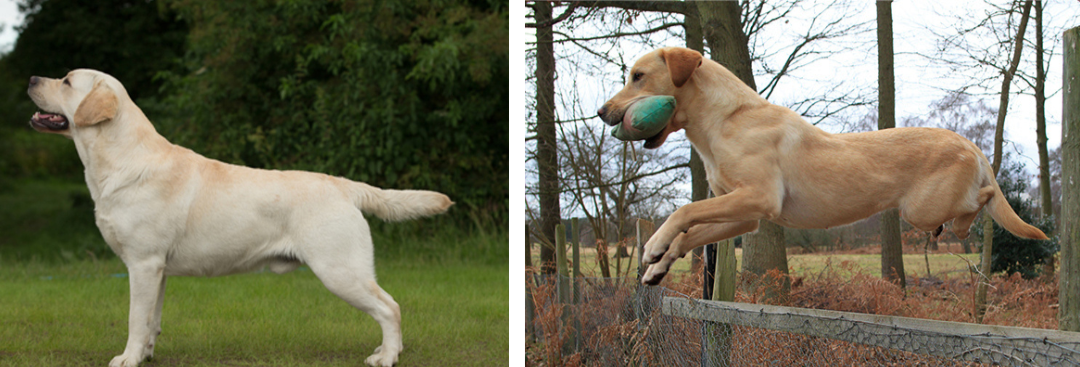
Left Show lilne Labrador. Right Working line Labrador.
Labradors
Show line Labradors tend to be heavier, broader and slower to mature. Thick coats. Deep chests. Strong bone. The classic otter tail, thick and muscular, designed for swimming and balance.
Working line Labradors are lighter, leaner and more athletic. Narrower heads. Less coat. Earlier maturity. In many lines the tail is thinner and longer, reflecting selection for speed and land work.
They are both Labradors. They are not built the same.
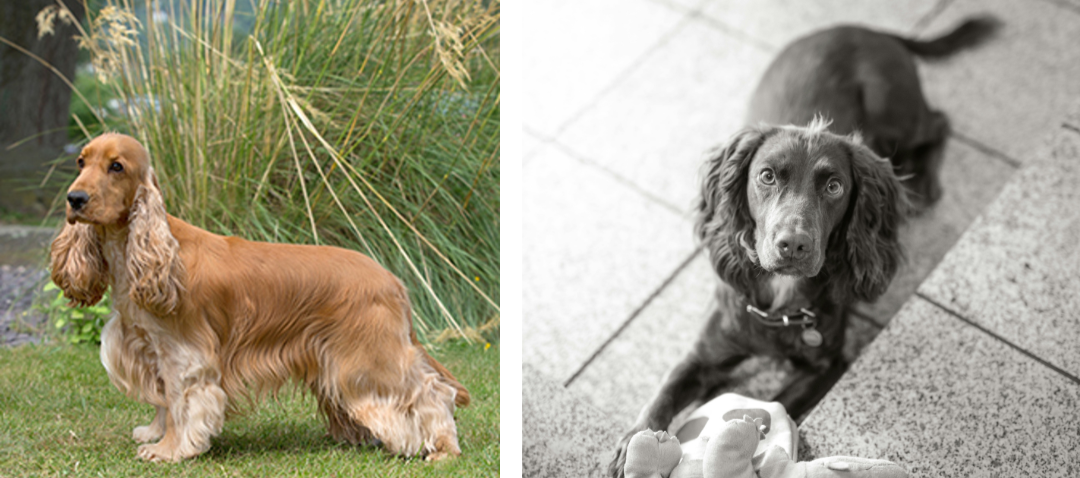
Left Show line Cocker Spaniel. Right Working Line Cockder Spaniel.
Cocker Spaniels
Show Cockers are heavier with more coat, more feathering and steadier movement.
Working Cockers are smaller, tighter and built like springs. Shorter coats. Less feathering. Faster reactions. Everything about them is designed for movement through cover.
Again. Same breed name. Very different dogs.
Why this shows up on the lead
Loose lead walking is one of the first places people notice the gap.
Working bred dogs notice everything. Scent, sound, movement. Expecting them to stroll politely without teaching them how to process all that information is unrealistic.
This is where tools like head collars often appear.
Head collars work in the sense that they stop pulling. But if the behaviour only exists while the tool is on, the dog has not learnt how to walk. They have learnt how the tool feels.
That makes it management, not training.
Management has a place. Safety matters. Support matters. But training is what changes behaviour long term.
Good walking is a conversation. Clear feedback. Consistency. Rewarding what you want rather than spending the whole walk fighting what you do not want.
Why avoiding problems does not fix them
Many owners start avoiding the situations their dog struggles with. Busy paths. Other dogs. New places.
It feels kinder. It also feels less embarrassing.
But avoidance does not build skills. It shrinks the dog’s world.
Dogs learn through supported exposure and practice. Not being thrown in at the deep end, but not being wrapped in cotton wool either.
A dog does not learn recall by never being distracted. They do not learn calm walking by only walking where nothing happens.
They need help navigating life.
How to choose the right dog for you
Before choosing a Labrador or Cocker Spaniel, ask yourself some uncomfortable questions.
How much time do you actually have
Do you enjoy training or tolerate it
Do you want a project or a companion
What does a normal week look like for you
Be honest. Not aspirational.
Choosing a show line dog because you want an easier life is not failure. Choosing a working line dog because you love training and structure is not reckless.
Problems happen when people buy the dog they like the look of rather than the dog that fits their life.
Do you know what you are buying?
Many people do not.
Breeders matter. Lines matter. The parents matter. The environment the puppy is raised in matters.
If you cannot answer whether a puppy is show bred or working bred, that is a sign to slow down and ask more questions.
When support matters most
Helping a dog learn how to cope with the world takes time, patience and skill.
A good trainer does not just train your dog. They teach you how to watch, read and communicate with the dog in front of you.
That support is invaluable, especially with working bred dogs in pet homes.

Final thought
Most behaviour problems are not training failures. They are expectation failures.
Train the dog you have. Not the one you thought you were buying.
That is where things start to get easier.