Dog Training Advice Should Help, Not Humiliate
When Did Dog Advice Become Public Shaming?
Every time the weather gets hot, the same thing happens.
Social media fills with posts about dogs being walked in the heat, dogs wearing certain equipment, dogs outside at the "wrong" time, dogs being managed in ways strangers do not agree with. And yes, dog safety in a heatwave matters. It matters a lot. Dogs can overheat quickly, and the advice from welfare organisations is consistent: walk during cooler parts of the day, provide shade and water, avoid hot pavements, watch carefully for signs of heatstroke.
But somewhere along the way, online dog culture stopped being about helping dogs and started becoming a public performance of outrage.
People post photos of strangers. They write captions dripping with disgust. They call people cruel, stupid, selfish, sickos, people who "don't deserve dogs". They tear apart someone they have never met, over a situation they do not fully understand, based on one moment in time. And then they call it education.
It is not education.
A single image on social media does not give you enough context to decide the whole story. You do not know why that dog is outside. You do not know how long they have been out. You do not know whether they have just stepped out for two minutes so the dog can go to the toilet because they live in a first-floor flat with no garden. You do not know whether the owner is following advice they were given by someone they trusted. You do not know whether that person or that dog has lived in a much hotter country, where this temperature is normal rather than unusual. You do not know what happened before the photo, after the photo, or outside the frame.
And that context matters.
Attacking people who may genuinely believe they are doing their best is not helpful. If nobody has ever shown you a better way, explained the risk properly, helped you understand your dog, or given you safe advice without making you feel like a terrible person, how are you supposed to do better?
Because this is the bit people seem to forget: vicious social media attacks do not create better dog owners. They create shame. They create silence. They make people hide. They make people frightened to ask questions. They make people less likely to say, "I think I need help," because every time they look online, help seems to come wrapped in judgement, humiliation and a comment section full of people waiting to pile on.
How can people ask for the right help when asking for help feels like walking into a firing line?
If the goal is genuinely to help dogs, then where is the humanity? Where is the guidance? Where is the grace for people who are learning? Where is the understanding that many owners are already overwhelmed, already confused, already trying to pick their way through conflicting advice and competing voices?
We can care deeply about dog welfare without ripping humans apart in the process.
We can hold people accountable without being cruel.
And we can build something better than an online culture where everyone is too scared to admit they need support. Because if people cannot ask without being attacked, dogs do not get helped. They just get talked about.
Heatwave Dog Advice Should Help, Not Humiliate
This is not an argument against giving heatwave advice.
Dogs can struggle in hot weather. Puppies, older dogs, overweight dogs, flat-faced breeds, thick-coated dogs, anyone with an underlying health condition. Heatstroke can become serious quickly, and owners need to understand that. Saying "please be careful in this weather" is not the problem. Encouraging people to walk earlier or later, avoid hot pavements, carry water, choose shade, shorten walks, or swap a walk for enrichment at home is sensible, practical advice.
The problem is what often comes with it.
The sneaky photo. The public post. The disgusted caption. The comment section full of people calling someone lazy, stupid, cruel, selfish, unfit to own a dog.
That is not welfare education.
That is humiliation dressed up as advocacy.
And context still matters. One image might show a genuine welfare concern. It might also show a dog on a two-minute toilet break because they live in a flat with no garden. It might show someone walking back from the vet. It might show a person who has only just arrived in this country and does not yet understand how quickly the UK's humidity, pavements and lack of shade can become a risk. It might show someone doing exactly what a previous trainer, breeder, friend or family member told them was fine.
You do not know the whole story from one photo.
That does not mean we ignore risk. It means we respond in a way that actually gives someone a chance to make a safer choice.
Because what is more useful? Posting someone's photo online with a caption calling them disgusting, or saying: "In this heat, dogs may only need toilet breaks rather than full walks during the hottest part of the day. Try early morning or late evening, check the pavement with the back of your hand, take water, stick to shade."
One gives people a route forward. The other gives them a reason to avoid you.
If your advice makes people too ashamed to come back and ask for help, it has failed. If your post gets hundreds of angry comments but the person involved never learns what to do differently, who did it actually serve?
Dogs need clear, practical information. They need owners who understand what heat stress looks like, when to stop, when to cool things down, and when to call a vet. But they also need humans who feel safe enough to learn.
So share the advice. Explain the risk. Be firm where you need to be firm.
But stop pretending that public shaming is the same as public education.
The Halti, The Choke Chain And The Hypocrisy Problem
The dog world loves a fight about tools.
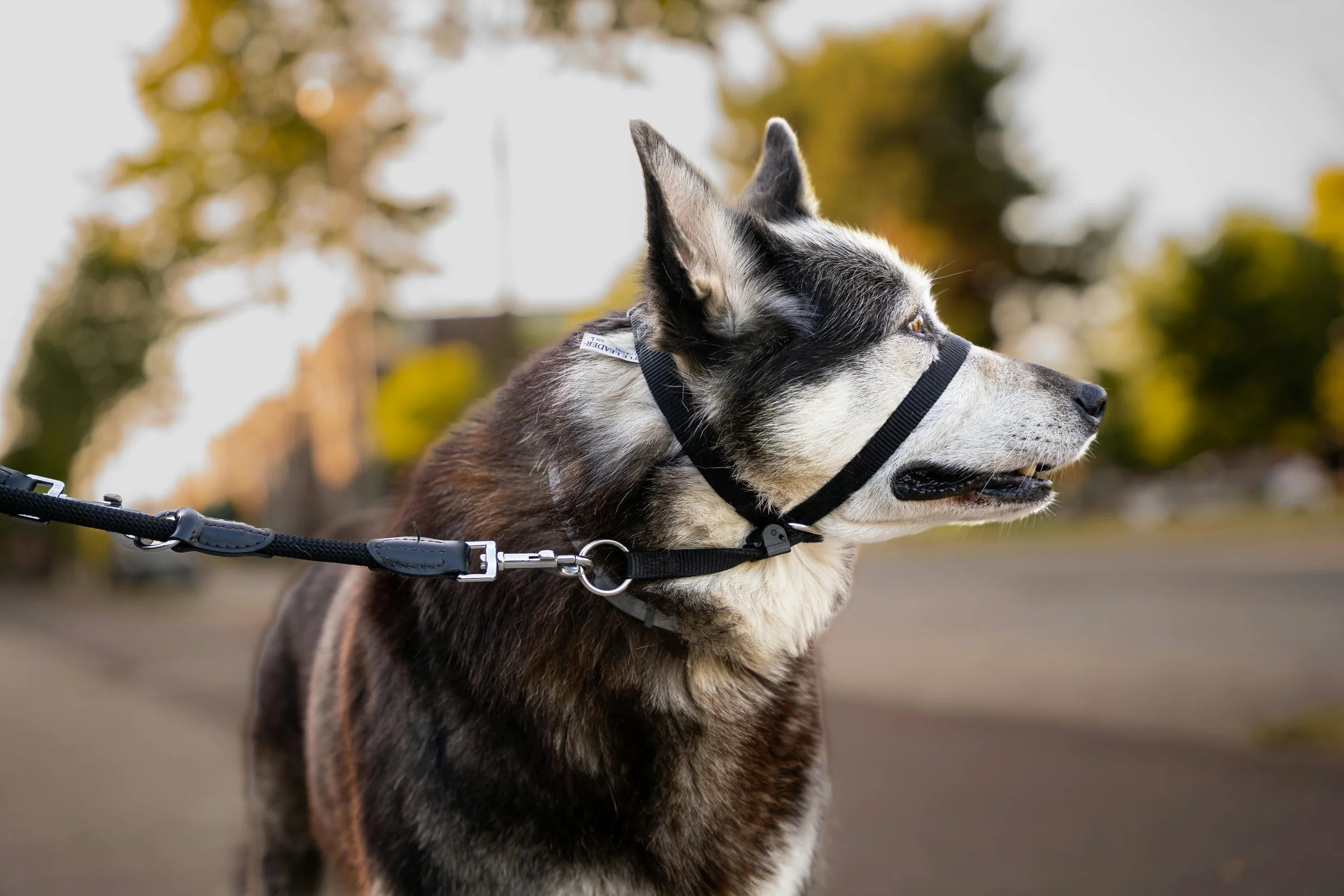
Haltis, harnesses, slip leads, choke chains, prong collars, long lines, flexi leads, muzzles. Name any piece of equipment and someone is ready to declare it either the answer to everything or the worst thing that has ever happened to dogs.
The problem is not that we are having conversations about tools. We should be. Equipment matters. Fit matters. How it is used matters. Why it is being used matters. Whether the dog has been introduced to it properly matters. Whether it is there for safety, management, communication, control, convenience or punishment matters.
The problem is the lack of honesty and consistency.
Because it is very difficult to take someone seriously when they are online declaring that haltis are cruel, that anyone using one is abusive, that no decent trainer would ever recommend one, and then you look at their own dog and it is standing there in a choke chain.
Where is the nuance? Where is the self-awareness? Where is the understanding that welfare concerns do not only apply to the tools we personally dislike?
This is where so much of online dog culture loses credibility. It becomes less about the dog in front of us and more about which training camp someone belongs to. People are not asking, "Is this dog safe? Is this dog comfortable? Is this being used fairly? Is there a plan to help this dog and owner progress?" They are asking, "Can I use this to prove my side is better than yours?"
And that helps nobody.
A halti can be poorly fitted. It can be misused. It can be stressful for a dog who has not been introduced to it carefully. It can be used as a shortcut instead of teaching skills. Those are valid concerns.
A choke chain is a different matter. The evidence against aversive equipment is not ambiguous. Studies have linked the use of choke chains, prong and shock collars with pain, fear, tracheal damage and an increased likelihood of defensive behaviour. It is not simply a question of fit or introduction. The mechanism of the tool is the problem.
Most people using one are not setting out to hurt their dog. They are doing what a trainer told them, what they grew up seeing, or what someone they trusted said was normal. That is exactly the problem this whole piece is about. People act on the information they have. And if the information is wrong, the answer is better information, not public humiliation.
But if someone has access to the evidence, understands what it says, and still publicly attacks halti users for cruelty while defending choke chains, that is not a welfare position. That is tribalism wearing welfare as a costume.
And owners get caught in the middle of it. They are told one tool is cruel by one professional, essential by another, outdated by someone else, and the only thing that works by the next. They are trying to keep their dog safe, walk down the street without being dragged, manage reactivity, stop their shoulders being pulled out, prevent their dog from lunging into traffic, or simply cope with the dog they have in the real world.
Then they come online and are told they are abusive because of a tool they may have been advised to use by another trainer.
That does not create trust. It creates panic.
If we want to talk about equipment, then let's talk about it properly. Not with sweeping moral superiority. Not with "anyone who uses this is cruel." Not with hypocrisy dressed up as ethics.
Ask better questions. Is the dog comfortable? Has the dog been conditioned to the equipment? Is it fitted correctly? Is the owner using it safely? Is there a training plan beyond the tool? Is the tool reducing risk, or creating more stress? Could there be a better option for this dog and this person?
That is a useful conversation.
Because the truth is, tools do not exist in a vacuum. They are part of a bigger picture. Sometimes that picture is thoughtful and temporary. Sometimes it is careless and harmful. Sometimes it is an owner desperately trying to manage a situation with the only advice they have been given.
And if we care about dogs, our job is not to stand at the edge of that picture and score points.
Our job is to help people understand what they are using, why they are using it, what their dog is experiencing, and what options they have next.
Public Shaming Does Not Make People Better Dog Owners
There is a belief online that if you shame people hard enough, they will suddenly become better.
They will see the post, read the comments, realise the error of their ways, change everything overnight and thank everyone for the public humiliation.
But that is not how people work.
Most people do not learn well when they feel attacked. They defend. They shut down. They hide. They double down. They stop asking questions because asking questions no longer feels safe. And in dog training, that is a serious problem, because the people who most need support are often the people who are already confused, overwhelmed or unsure whether the advice they have been given is right.
Attacking someone who may genuinely think they are doing their best does not help them do better. It just tells them that the dog world is not a safe place to admit they do not know something.
And you do not know what you do not know. If someone has never been taught how quickly a dog can overheat, how to read stress signals, how equipment should be fitted, why a behaviour is happening, or what an ethical training plan should look like, then shouting at them does not magically give them that knowledge. It just makes them feel stupid for not already having it.
How is that helpful?
How are people supposed to ask for the right help when every mistake is met with criticism and judgement? How are they supposed to say, "I think I've been given bad advice," when the response they see online is people being ripped apart for following bad advice? How are they supposed to question a trainer when the whole industry feels like a minefield of labels and public takedowns?
This is how people end up stuck.
They stay with the wrong advice because they are too embarrassed to admit they are struggling. They keep using methods that make them uncomfortable because a professional told them to. They stop posting, stop asking, stop reaching out, and carry on behind closed doors because at least there nobody is laughing at them.
And the dog is the one left living with the consequences.
If someone is walking their dog in unsafe heat, using equipment poorly, handling their dog harshly, or misunderstanding their dog's behaviour, then yes, that needs addressing. But it needs addressing in a way that gives them a next step. Clear enough that they understand the risk. Supportive enough that they feel able to change.
Because shame is not a training plan.
A comment section full of strangers calling someone disgusting is not a training plan.
A viral post is not a training plan.
If we want better outcomes for dogs, we need to stop confusing outrage with impact. Outrage might get engagement. It might make your audience agree because they already think the same way. But does it reach the person who needs help? Does it help them understand their dog? Does it give them somewhere to go next?
If the answer is no, then we need to be honest about what we are doing. We are not educating. We are venting. We are performing. We are using someone else's mistake, or what we assume is a mistake, as content.
And dogs deserve better than that.
People deserve better than that too. Not because every choice is acceptable. Not because welfare does not matter. Not because we should sit quietly and let harmful advice go unchallenged.
But because people learn better when they are given room to learn. They learn better when they are met with guidance instead of contempt. They learn better when they can ask "why?" without being made to feel ridiculous. They learn better when someone explains the risk, shows them another way, and gives them the confidence to try again.
That is how you help the dog in front of you.
Not by pushing their person further into shame.
When Professional Labels Harm Dogs And Owners
It is one thing for a stranger on the internet to make a careless assumption about a dog.
It is another thing entirely when that assumption comes from a professional.
Professional labels carry weight. When a trainer, behaviourist, walker, groomer, vet, or anyone in a position of trust says, "That dog is aggressive," it can change everything. It changes how the owner sees their dog. It changes how other people treat the dog. It changes what the dog is exposed to, what they are denied, what they are forced through, and how much fear sits in the relationship.
And sometimes, those labels are wrong.
I have worked with a client whose Doberman had been through multiple trainers and had been repeatedly labelled as aggressive. That word followed them. It shaped the way the dog was managed. It shaped the way the owner felt. It shaped the expectation before the dog had even done anything.
One trainer hit the dog with an agility pole because of this supposed aggression.
A dog who was already being misunderstood was met with more pressure, more fear, more force, and more confirmation for the human that they had a dangerous dog on their hands.
We have been working together for a couple of months now, and it is clear to me that this dog is not aggressive.
That does not mean there was nothing going on. It does not mean the owner did not need help. It does not mean the dog did not need understanding, structure, support, clearer communication and a plan. But "aggressive" was not the full picture. It was not even an accurate one.
And that matters.
Because once a dog is labelled, people often stop looking. They stop asking what the behaviour is actually communicating. They stop asking whether the dog is scared, overwhelmed, frustrated, conflicted, in pain, confused, over-aroused or simply unable to cope in that environment. They stop asking what has been reinforced, what has been punished, what has been ignored, and what the dog has learnt they need to do to create space or feel safe.
The label becomes the explanation.
And that is dangerous.
When a professional gets it wrong, the fallout can be significant. Owners may become frightened of their own dogs. Dogs may be handled more harshly because people believe they need firmness. Opportunities for proper support get missed because everyone is responding to the label instead of the individual. The dog's world gets smaller and smaller, not because that is what the dog needs, but because people are managing a story they were told.
There is a difference between saying, "This behaviour has the potential to be unsafe and we need to manage it properly," and saying, "Your dog is aggressive," as if that is the whole identity of the dog.
There is a difference between assessing behaviour and branding a dog.
There is a difference between helping an owner understand risk and making them afraid of the animal they live with.
And none of that means we should be vague about serious risk. When something is dangerous, say so clearly. Name it. Give it context. Give it a plan that protects the dog and the people around them.
But our words do not just describe dogs. They shape how dogs are treated. That is a responsibility professionals cannot afford to treat carelessly.
Owners let us into their homes, their routines, their relationships, their fears. They tell us the bits they are embarrassed about. They hand over the dog they love and say, "Please help me understand what is happening."
That trust matters.
And if the advice they receive leaves them more confused, more ashamed, more frightened, or more disconnected from their dog, we have to ask whether we are actually helping. Or whether we are just making it harder for everyone who comes after us.
Accountability Is Not The Same As Cruelty
People hear "stop shaming" and translate it into "never challenge anyone."
That is not what this is about.
Of course people need to be challenged sometimes. Of course unsafe choices need to be addressed. Of course dogs need advocates. If a dog is being put at risk in the heat, handled in a way that causes fear or pain, pushed past their limits, ignored when they are clearly struggling, or trained with methods that damage their welfare, then no, we should not stay silent.
But accountability and cruelty are not the same thing.
Accountability says, "This is risky, and here is what you need to understand." Cruelty says, "You are disgusting and should not own a dog."
Accountability says, "This equipment does not look safe or well fitted. Let's talk about what is happening and what your options are." Cruelty says, "Anyone using that is abusive."
Accountability says, "Your dog is showing signs they are not coping. We need to change the plan." Cruelty says, "You have ruined that dog."
One gives the person information, direction and a way forward. The other gives them shame.
And shame is not the same as responsibility.
There are times when we need to be firm. There are times when we need to say, "No, I would not continue doing that." There are times when we need to step in, set boundaries, report genuine welfare concerns, or make it very clear that a dog's needs are not being met.
But even then, the goal should be change, not humiliation.
Because if our response makes someone so defensive, frightened or ashamed that they cannot hear the message, then the message is unlikely to help the dog. It might make us feel righteous. It might make us feel like we have taken a stand. But feeling righteous is not the same as being effective.
That is the question we need to ask more often: do I want to help, or do I want to be seen being right? Because those are not always the same thing.
Helping often looks far less dramatic. It looks like explaining the same thing calmly for the fifth time. It looks like meeting someone where they are, even when you wish they knew more. It looks like saying, "I can see why you thought that, but here is why I would do it differently." It looks like giving someone a practical alternative, not just tearing down the choice they made.
It also looks like being honest without being vicious.
You can say, "Walking in this heat can be dangerous," without calling someone a monster. You can say, "That method can cause harm," without making the owner feel beyond redemption. You can say, "I would not use that tool in that way," without turning the person into content. You can say, "Your dog needs support," without making the owner feel like they have failed beyond repair.
That is accountability. It has standards. It has boundaries. It does not excuse harm. It does not pretend every choice is fine. It does not water down welfare concerns to avoid discomfort.
But it leaves the door open for learning.
Cruelty slams that door shut and then congratulates itself for caring.
Sometimes harshness is just laziness. Sometimes it is a way to avoid doing the harder work of actually teaching. And if we are serious about welfare, better training and better outcomes for dogs, we have to stop pretending that being harsh automatically means being honest.
Dogs need advocates. But advocacy should create safer dogs, better informed owners and clearer paths forward.
Not a crowd of people competing to be the most outraged voice in the comments.
You Are Your Dog’s Advocate, Even In Front Of A Professional
This part matters.
You are your dog’s advocate.
Not your trainer. Not the person with the loudest social media following. Not the person with the longest list of qualifications. Not the person who has “done this for years”. You.
You are the one who lives with your dog. You are the one who sees the fallout after a session. You are the one who notices the little changes: the way they hesitate before getting out of the car, the way they avoid the training field, the way they shut down when a certain piece of equipment comes out, the way they look to you when something feels too much.
You are their voice.
And that means if something does not feel right to you, you are allowed to pause.
You are allowed to ask why.
You are allowed to say, “Can you explain what this is teaching my dog?”
You are allowed to ask, “What is my dog feeling here?”
You are allowed to ask, “Is there another way we can approach this?”
You are allowed to say, “I am not comfortable doing that.”
And no decent professional should punish you for that.
Because just because someone advertises how qualified they are, how experienced they are, how many dogs they have worked with, or how many letters they have after their name, it does not mean you have to hand over your instincts at the door.
It does not mean you have to do something that makes your stomach twist.
It does not mean you have to keep going when your dog is clearly struggling.
It does not mean you have to accept “because I said so” as an explanation.
A good trainer should be able to explain their choices. Not in a defensive, patronising or dismissive way. Not by making you feel stupid for asking. Not by rolling their eyes and telling you to trust the process.
They should be able to explain why they are doing something, what your dog is learning, what signs they are watching for, what the risks are, and what alternatives exist.
And “because it works” is not enough.
Lots of things “work” if all we care about is stopping behaviour. Fear can stop behaviour. Pain can stop behaviour. Intimidation can stop behaviour. Confusion can stop behaviour. A dog shutting down can look very convenient if you are not interested in how they feel.
So no, “it works” is not a good enough answer.
“Because I always have” is not a good enough answer.
“Because I’m the professional” is not a good enough answer.
“Because your dog needs to learn” is not a good enough answer.
Your dog is always learning. The question is what are they learning, and at what cost?
Are they learning that you are safe?
Are they learning that communication works?
Are they learning that the world is more manageable than they thought?
Are they learning the skills they need to cope?
Or are they learning that their voice does not matter, their discomfort will be ignored, and the human they trust will not step in?
That is not a small thing.
When something in training feels wrong, owners need to feel safe enough to say so. They need to know they can advocate for their dog without being mocked, blamed or told they are the problem. They need trainers who welcome questions, not trainers who treat questions as disrespect.
Because asking why is not being difficult.
It is being responsible.
And if a professional cannot explain what they are doing without hiding behind ego, jargon or authority, then that is not your failure. That is information.
It tells you something important about the space you and your dog are in.
Training should not require you to silence the part of yourself that says, “This does not feel okay.” Sometimes that part is fear. Sometimes it is uncertainty. Sometimes it is lack of knowledge. But sometimes it is your gut noticing that your dog is being pushed somewhere they should not be pushed.
Listen to it.
Ask the question.
Pause the session.
Change the plan.
Walk away if you need to.
Because your dog cannot choose the trainer. Your dog cannot read the website. Your dog cannot check the qualifications. Your dog cannot say, “I do not feel safe with this.”
That responsibility sits with us.
And yes, that can feel heavy. But it is also powerful.
You do not have to know everything to advocate for your dog. You do not have to be a trainer. You do not have to have all the answers. You just have to be willing to notice, to ask, to learn, and to say no when something does not sit right.
That is not weakness.
That is care.
What Supportive Dog Training Guidance Should Look Like
Supportive dog training guidance is not soft.
It is not vague, permissive or an excuse for poor choices. It does not avoid difficult conversations to spare someone's feelings.
Supportive guidance still has standards.
It still says, "That is not safe."
It still says, "Your dog is struggling."
It still says, "I would not continue doing that."
It still says, "There is a better way."
But the difference is that it gives people somewhere to go next.
Too much of what passes for advice online only tells people what they are doing wrong. It is less interested in helping them understand what to do instead. And if your advice only leaves someone feeling ashamed, defensive and lost, it is not doing the job you think it is doing.
Useful guidance should explain the risk, not just announce the judgement.
If someone is walking their dog in the heat, tell them why that can be dangerous. Explain that dogs cannot cool themselves the way humans do. Explain that pavements can become hot enough to hurt paws. Explain that some dogs are more vulnerable than others. Then give them options: toilet breaks only, early morning or late evening walks, shaded routes, water, home enrichment, scent games, training indoors, rest.
That is helpful.
If someone is using a piece of equipment poorly, tell them what concerns you. Explain fit. Explain pressure. Explain what the dog might be learning and what signs of discomfort to look for. Then offer alternatives, or at least suggest they speak to someone who can help them use it safely while working towards better skills.
That is helpful.
If someone's dog is reacting, barking, lunging, freezing, growling or snapping, do not slap a label on the dog and leave the owner frightened. Explain that behaviour is communication. Explain that the dog may be scared, frustrated, overwhelmed, in pain, conflicted or simply unable to cope. Help the owner understand what they need to look at next, and where to get proper support.
That is where advice actually does something.
Supportive guidance should make people feel more capable, not more helpless. It should make them think, "Okay, I understand this better now. I know what to change. I know what to ask. I know where to start."
Not, "I am awful. Everyone is judging me. I will never ask again."
Because learning requires safety.
That does not mean comfort all the time. Sometimes learning is uncomfortable. Sometimes people need to hear that something they are doing is not fair to their dog. Sometimes owners need to sit with the fact that good intentions do not erase impact. That is part of growth.
But discomfort and humiliation are not the same thing.
A safe learning space can challenge you without crushing you. It can correct you without mocking you. It can be honest without being cruel. It can say, "This needs to change," while still making it clear that change is possible.
That is the kind of dog training space more people need.
One where owners can say, "I do not know what I am doing," without being made to feel stupid.
One where they can say, "A trainer told me to do this, but it feels wrong," and be taken seriously.
One where they can say, "I think I have made mistakes," and the response is support, not punishment.
One where the dog is advocated for fiercely, and the human is guided firmly but fairly.
Because supporting owners is not separate from supporting dogs. It is part of it.
Your dog does not live in a comment section. They live with you. They learn through you. They rely on your understanding, your confidence, your choices and your ability to ask for help when something is not working.
So if we want dogs to have better lives, we need to help their people become better informed, more confident and more connected.
Not more ashamed.
Not more defensive.
Not more afraid.
Better supported. Better equipped. Better able to understand the dog in front of them.
Dog Professionals Need To Take Responsibility Online
Dog professionals need to think carefully about how they show up online.
Not because we should be bland. Not because we should avoid having opinions. Not because welfare conversations need to be watered down until they mean nothing.
But because people are listening.
When trainers, behaviourists, walkers, groomers, vets, influencers and experienced dog people post with contempt, that contempt spreads. When we mock owners, our audience learns that mocking owners is acceptable. When we take one image, one clip, one moment and turn it into a public pile-on, we teach people that judgement is more valuable than understanding.
And then we wonder why owners are scared to ask for help.
We have to take responsibility for that.
If you have built a platform around dogs, people will treat your words as guidance, even when you are "just venting." They will copy your tone. They will repeat your phrases. They will absorb your attitude towards owners, towards certain breeds, towards certain tools, towards certain behaviours.
That is influence. And influence comes with responsibility.
It is not enough to say, "Well, I am just passionate." Passion does not excuse cruelty. Experience does not excuse arrogance. Qualifications do not excuse public humiliation. Caring about dogs does not give anyone a free pass to rip humans apart for engagement.
Because that is what some of this is.
Engagement.
Rage travels fast online. Outrage gets comments. Shame gets shares. A post calling someone disgusting will often go further than a post calmly explaining how to keep a dog safe in hot weather. But we need to ask ourselves what we are feeding when we choose that route.
Are we helping the dog? Are we helping the owner? Are we improving welfare? Or are we building an audience that enjoys watching people be torn down?
Those are uncomfortable questions. But they matter.
And they matter even more when professionals are involved. Because owners come to us already carrying doubt, guilt, confusion and often a history of being told different things by different people. Some have been blamed for their dog's behaviour. Some have been told their dog is dominant, stubborn, aggressive, dramatic, manipulative or beyond help. Some have paid good money to be made to feel smaller.
We should not be adding to that.
We should be modelling something better.
That does not mean never disagreeing. It does not mean never calling out harmful advice. It does not mean sitting silently while dogs are put at risk. There is a place for strong opinions, professional challenge, and saying, "No, I do not agree with this, and here is why."
But "here is why" matters. Context matters. Alternatives matter. Tone matters.
If you are going to call something out, educate while you do it. Explain the concern. Explain what people can do instead. Explain where the risk lies and why the dog's welfare is affected. Give people a way to change, not just a reason to feel attacked.
And before posting, ask:
Am I helping, or am I performing?
Would I say this to the owner's face if they were already ashamed?
Have I given people a next step?
Have I considered that I may not have the full context?
Am I using this dog and owner as an example, or as content?
Would this post make someone more likely or less likely to ask for help?
Because if the answer is that it would make people hide, then we need to think very carefully about whether it serves dogs at all.
Dog professionals do not have to be perfect online. None of us are. We all get frustrated. We all see things that make us angry. We all have moments where we want to scream into the void because we care so much and we are tired of seeing dogs misunderstood.
But frustration still needs responsibility.
If we want owners to be thoughtful, reflective and open to learning, we have to model that too.
If we want people to question advice that feels wrong, we have to create spaces where questions are welcome.
If we want better welfare, we have to stop using shame as our main teaching tool.
Because the dog world has enough outrage.
What it needs is more people willing to be clear, honest, firm and humane at the same time.
We Can Build Something Better Than This
Dogs deserve better than being used as fuel for online outrage.
They deserve to be protected in hot weather. They deserve thoughtful handling. They deserve equipment that is safe, fair and properly understood. They deserve training that considers how they feel, what they are learning, and what they need from the humans around them.
But they also need their humans to feel safe enough to learn.
Because most owners are not out here trying to get it wrong. They are trying to do their best with the information they have. Sometimes that information is incomplete. Sometimes it is outdated. Sometimes it has come from a professional they trusted. Sometimes it has been shaped by fear, embarrassment, bad advice, or a dog training world that can feel impossible to navigate.
And you do not know what you do not know.
That is why vicious social media attacks are not the answer. They do not create understanding. They do not build confidence. They do not make people more likely to ask questions, challenge poor advice, or reach out when something feels wrong. They make people hide. They make people defensive. They push people further away from the support their dogs may desperately need.
We can hold standards without losing compassion.
We can challenge unsafe advice without humiliating people.
We can advocate fiercely for dogs while still recognising that owners need guidance, not public destruction.
We can create spaces where people are allowed to ask, "Why?" Where they can say, "This does not feel right." Where they can admit, "I think I need help," without being met with judgement before they have even finished the sentence.
That does not mean anything goes. It does not mean welfare concerns should be ignored. It does not mean all methods, tools or choices are equal. It means we care enough to actually help, not just shout from the sidelines.
It is about understanding the dog in front of us. It is about supporting the human who lives with that dog. It is about building better communication, better trust, better safety and better relationships.
So if you are feeling judged, confused, embarrassed, or unsure about something you have been told to do with your dog, you are not alone. If something in training has felt wrong, you are allowed to question it. If you are worried about your dog's behaviour, the equipment you are using, or whether the advice you have been given is right for you, you are allowed to ask for help.
Reach out for non-judgemental advice.
We can talk through what is going on, see whether we are a good fit, and help you build a better relationship with your dog.
Because you and your dog deserve more than judgement.
You deserve support that actually helps.