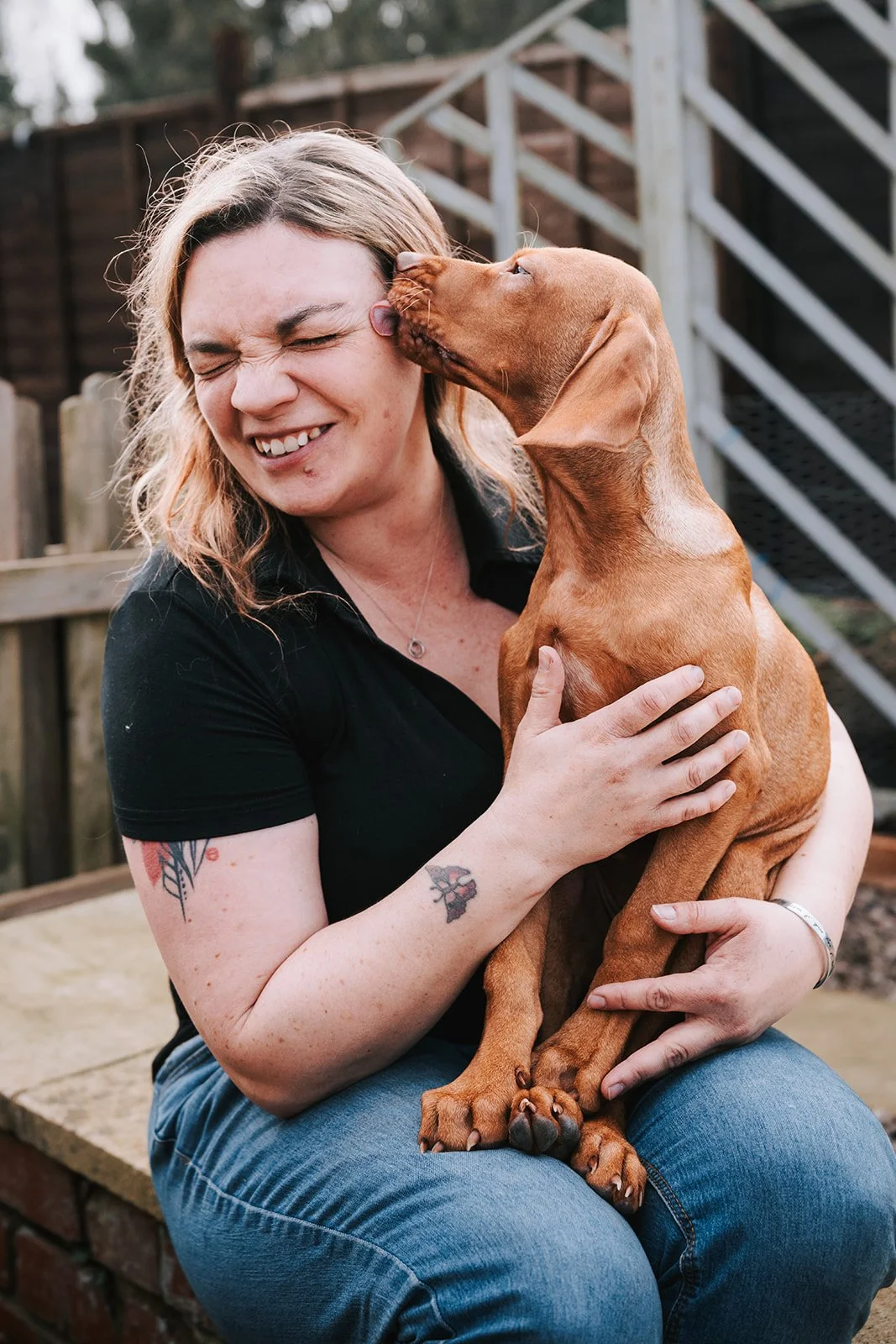
Meet Sam
I don't believe every dog needs the same answer.
I believe every dog deserves to be understood.
If you're thinking about trusting me with your dog, it's only fair you know a little about the person on the other end of the lead.
I'm Sam, the face behind Ricochet Dog Training, and if there's one thing that's been consistent throughout my life it's that I've always been slightly obsessed with dogs. Unfortunately, my dad didn't quite share that enthusiasm.
I spent most of my childhood asking for a dog and being told no. Every birthday, every Christmas and pretty much every opportunity in between. Eventually I accepted defeat and started borrowing the neighbour's dog instead. I walked him whenever they'd let me and, for a little while at least, pretended he was mine.
By the time I reached sixth form I still wasn't allowed a dog, so I got a job in kennels instead. It wasn't quite the same, but it was the closest I could get.
The very first thing I did after leaving home was buy a dog.
I still joke with my dad that if he'd just let me have one as a child, perhaps I wouldn't have become quite so obsessed. Somehow I don't think he believes me.
So... who am I?
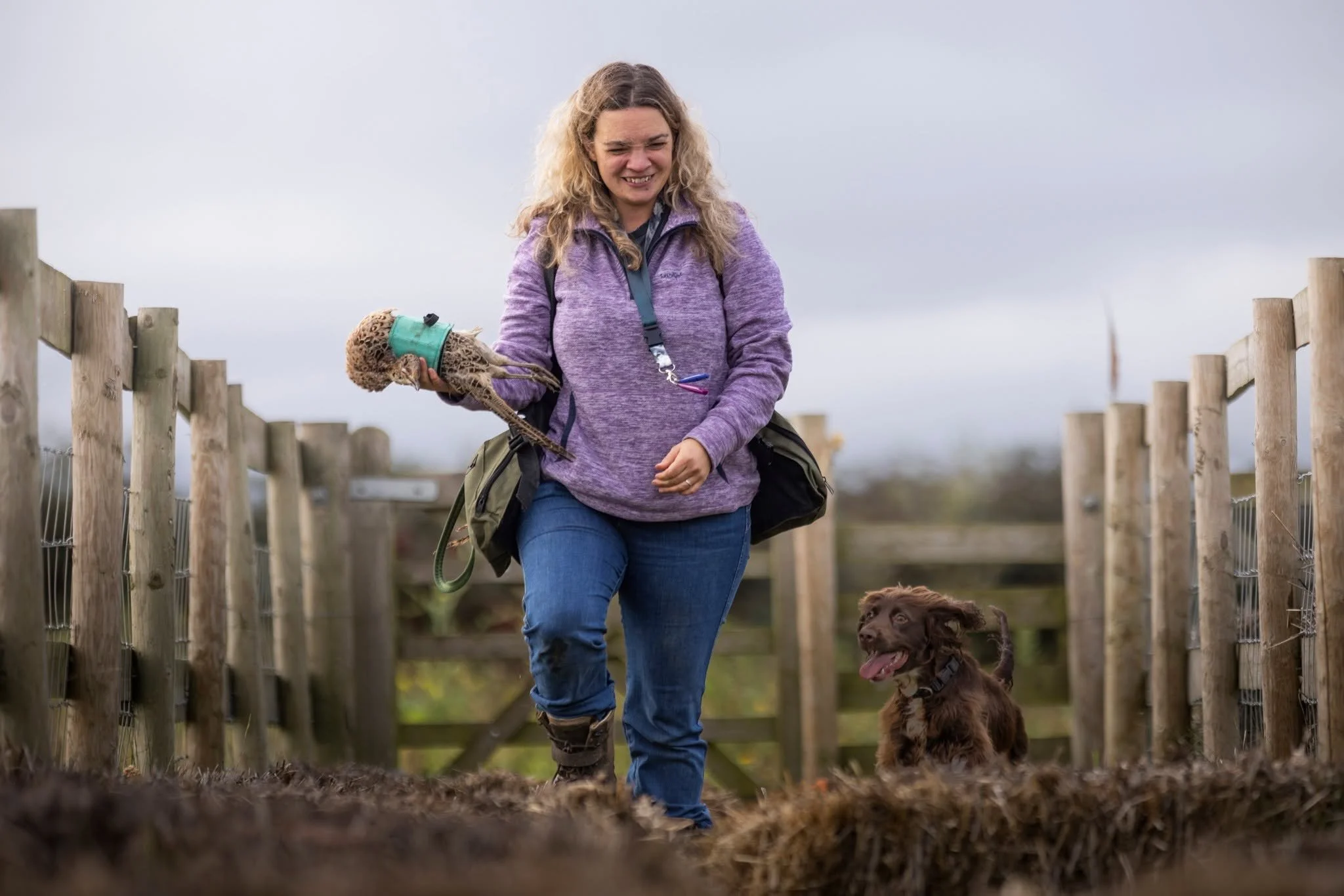
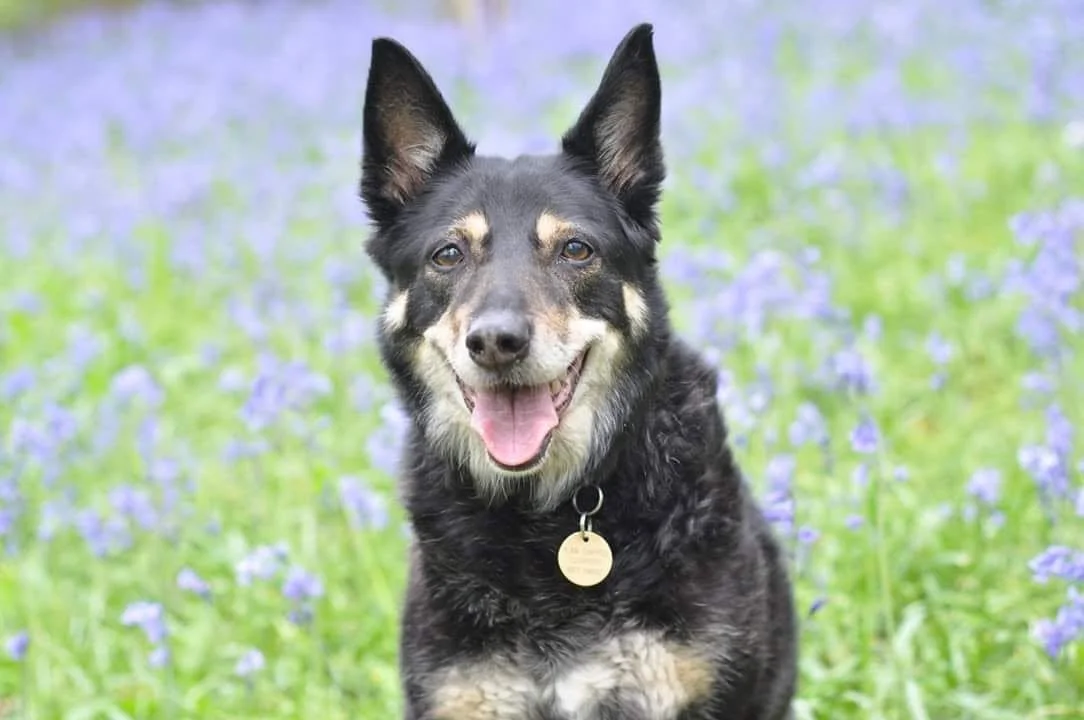
It all started with one dog.
Like most owners, I thought I was fairly well prepared.
I'd read the books, listened to advice and had a plan for how
things were going to go.
Then I got a dog.
It turns out dogs have a wonderful habit of exposing every gap
in your knowledge.
Instead of putting me off, it made me curious. One question led
to another, then another, until reading about dogs became attending
courses, attending courses became collecting qualifications and
collecting qualifications became a career I genuinely can't imagine doing
anything else.
Along the way I've worked in rescue kennels, helped raise Guide Dog
puppies and had the privilege of working with hundreds of dogs and
their owners. Every single one has taught me something.
That's probably why I still enjoy learning as much now as I did at the
beginning. Every time I think I've got a decent handle on something,
another dog comes along and reminds me there is considerably more to it.
Why I train the way I do
People sometimes ask where my approach to training comes from, and there isn't really one course, qualification or trainer I can point to. It has changed over time, partly through working with dogs, but also through life and learning how differently we all understand and process information.
Being a mum has had a big influence on that. My son is autistic, and one of the things I've learnt is that communication has to work for the person receiving it, not just make sense to the person giving it. If I've explained something and it hasn't been understood, saying exactly the same thing again, only louder and with considerably more irritation, isn't suddenly going to make me an excellent communicator. I need to change something.
That has inevitably influenced how I work with dogs too. We can be terribly quick to decide a dog "knows" something because they did it successfully once, and then get frustrated when they can't do it somewhere else. But managing a lovely sit in the kitchen on Tuesday doesn't necessarily mean you've mastered sitting outside the pub on Saturday while another dog walks past and somebody drops a chip.
Learning takes repetition, context and time, and different individuals need different things from us along the way. So if a dog is struggling, I'm much more interested in working out what they have understood, what I might have assumed and what I can change to make things clearer. Getting annoyed with them doesn't give either of us any useful information.
That same thinking applies to the people I teach. I don't expect every client to learn in the same way either, and I'm quite happy to explain something differently, demonstrate it, change the exercise or abandon my original plan altogether if it isn't working for the person and dog standing in front of me. The plan is allowed to change. In fact, it frequently does.
“Communication has to work for the person receiving it, not just make sense to the person giving it.”
What will it actually be like to work with me?
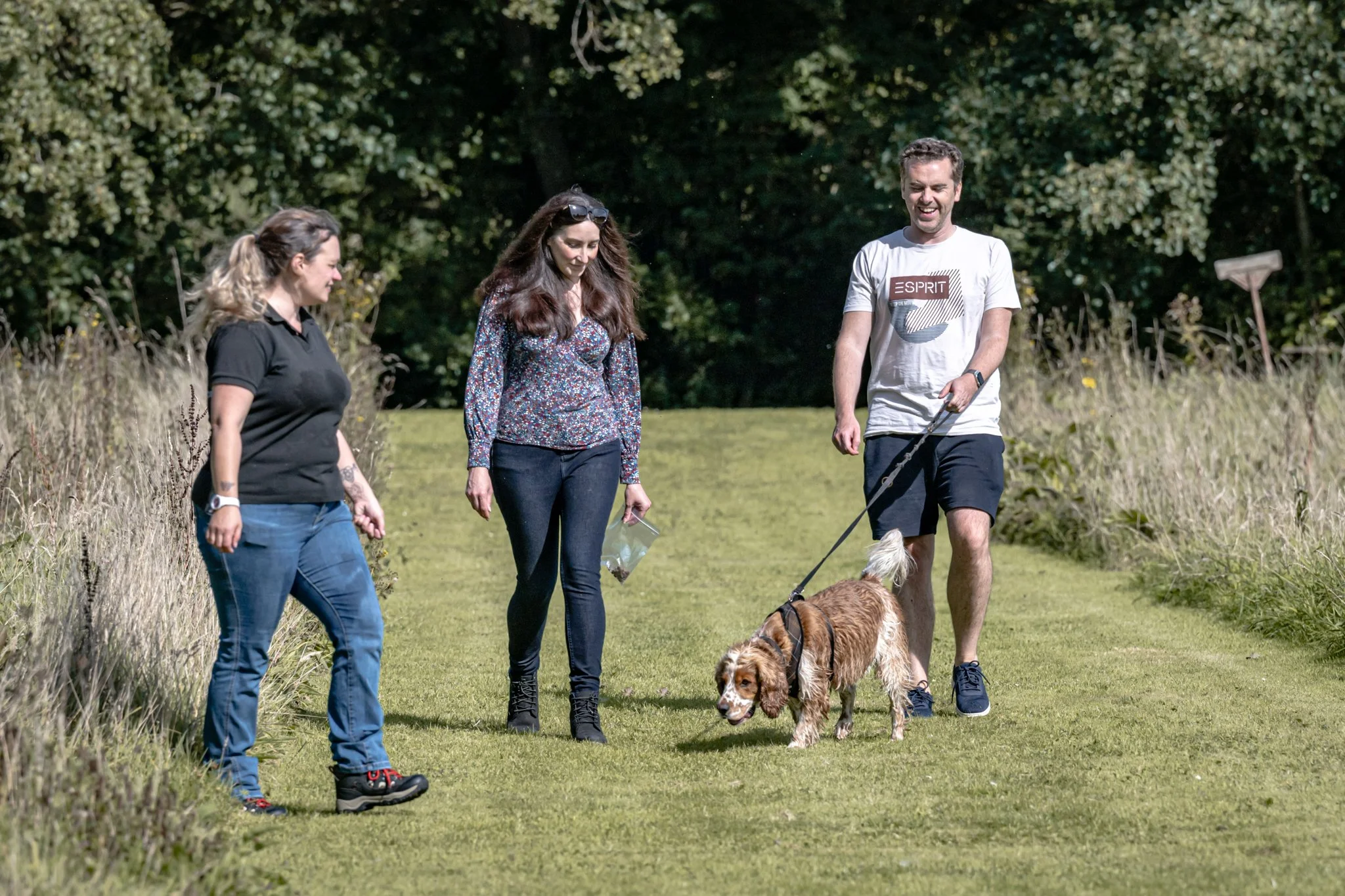
I ask a lot of questions and I spend a lot of time watching dogs. Occasionally this means it might look as though I'm doing absolutely nothing, but I promise there is usually some work taking place.
I want to know what normal life looks like for you and your dog, not just what happens when everything goes spectacularly wrong. I'll want to know what they enjoy, where they struggle, what you've already tried and what you'd actually like life together to look like. There isn't much point in me creating a technically beautiful training plan that requires you to reorganise your entire life around the dog. It has to work when I'm not there too.
By the time somebody contacts me, they've often already had a lot of advice. They've watched videos, read posts, spoken to friends and family and probably met somebody in a park who has owned dogs for forty years and diagnosed theirs from fifty yards away.
So I'm not interested in adding another voice telling you everything you've apparently done wrong. I want to help you make sense of what's happening now, decide what actually matters and find a way forwards that works for both of you. Sometimes that involves teaching new skills, sometimes we change the environment or our expectations, and quite often we do a bit of everything.

There is a slightly dangerous assumption that because somebody is a dog trainer, their own dogs must behave impeccably at all times. I can confirm that Callisto, Cassidy and Drift have not agreed to participate in maintaining that illusion.
They've all challenged me in different ways and made me rethink things I was fairly sure I understood. They also have an impressive ability to demonstrate their individuality immediately after somebody discovers what I do for a living. Nothing keeps your professional ego under control quite like calling your own dog across a field while they pause to consider whether your suggestion has sufficient merit.
And I wouldn't actually want it any other way. Living with my own dogs is a constant reminder that learning isn't finished because something went brilliantly last Tuesday. Things change, dogs change and sometimes something you thought you'd cracked needs a bit more work. It means I'm considerably less interested in perfection and much more interested in what works for the dog and human actually living together.
My own dogs keep me grounded
I've collected a fair number of qualifications over the years, although collecting certificates has never really been the point. What matters is what I've learnt while getting them. Every course has added something, challenged something I thought I knew or sent me away with another collection of questions. Apparently I'm incapable of simply learning something and leaving it there.
I am proud of my qualifications because if you're trusting somebody with your dog, I think you should be able to see that they've put proper work into learning their job. But getting qualified isn't the point where you get to announce that you've completed dogs. I'm fairly confident nobody has.
I still study, attend courses, watch other professionals work and change what I do when the evidence gives me a good reason to. The dogs and people I work with teach me plenty too, and I'd be slightly concerned if I ever reached the point where I thought I'd learnt enough.
I still keep learning
Professional credentials
Gundog Trainers Academy GTA AD
ABTC Animal Training Instructor (ATI)
City & Guilds Scent Dog Handler and Instructor Course –
The College of Scent DogsCAP 1 and CAP 2 - Clicker Assessment Programme
Dog First Aid UK - Canine First Aid Certification
The qualifications above aren't where the learning stopped. I regularly undertake further study in behaviour, reactivity, cooperative care, Free Work, confidence, loose lead walking, first aid and whatever else the dogs persuade me I need to know more about.
Think we'd get along?
If you've made it this far, you probably have a reasonable idea of what working with me is going to be like. I won't expect your dog to be perfect, I won't expect you to have all the answers and I'm quite happy to change the plan when either of you tells me it isn't working.
You don't need to know which service you need before you get in touch either. Tell me a bit about your dog, what life looks like at the moment and what you'd like some help with. We can work out the sensible place to start from there.
I can't promise you a perfect dog. Mine would make that a fairly difficult claim to defend. But I can help you understand the one you've got and find ways to make life together work better for both of you.